Minaki: Railway Dreams and a Lodge That Wouldn't Quit
By The hosts
You know how every good place has a story behind why anyone ever came here in the first place? Minaki's is a good one, so grab a coffee - or something stronger, it's that kind of story.
Before there were cottages and fishing boats, this was canoe country. The Winnipeg River system has carried people for thousands of years. The Anishinaabe traveled and lived along these waters long before any European set eyes on them, and the river became the great highway of the fur trade - voyageurs, the Hudson's Bay Company, all of it. There was even a Hudson's Bay trading post a couple of kilometres north of where the village sits today. So when you're out on the water at dusk, you're paddling a route that's been traveled for longer than almost anywhere in the country.
The railway changed everything
The modern story starts around 1910. The National Transcontinental Railway pushed a bridge across the river near a spot a fellow named Skipper Holst had already set up a little hotel. They called the place Winnipeg River Crossing back then - not exactly poetry. In 1914 it got renamed Minaki, an Ojibwe word that's been translated as 'beautiful water' or 'good land.' Both fit, honestly. Whoever picked that name knew what they were doing.
The railway companies looked at all this water and forest and thought what anyone would think: people would pay to come here. In 1913 they unveiled plans for a hundred-thousand-dollar resort - serious money then - and the Minaki Inn opened on June 26th, 1914. Dining room, dance hall, rooms for 250 guests. Five dollars a night, meals included. Picture that: people stepping off a train in the middle of the boreal forest into a dance hall by the river.
The lodge that kept burning down
Here's where it gets wild. In 1925 a fire started in the power plant and burned the whole Inn to the ground. You'd think that'd be the end of it. It wasn't.
The railway's president, Sir Henry Thornton, decided to rebuild - bigger. He brought in Scottish stonemasons, Swedish log cutters, and English gardeners. They built a soaring granite-and-log lodge that opened in 1927. And get this: there's solid rock everywhere up here - it's the Canadian Shield - so to put in a golf course they hauled in thirty trainloads of soil from a farm in Manitoba. Thirty. Trainloads. Of dirt. To grow grass on a rock.
Minaki Lodge was the real deal - a luxury resort right through to after the Second World War. Then travel patterns shifted, the railway lost interest in passengers, and it got sold off in the early '50s. After that it had more lives than a cat. The Ontario government owned it for a stretch and poured something like fifty million into renovations, then sold it for four. Politicians called it 'the Jewel of the North'; the other side called it a boondoggle. It passed through all kinds of hands.
And then in October 2003, the grand main building - uninsured, of all things - burned to the ground in a spectacular fire. For the third time, more or less, fire had the final word.
What's left
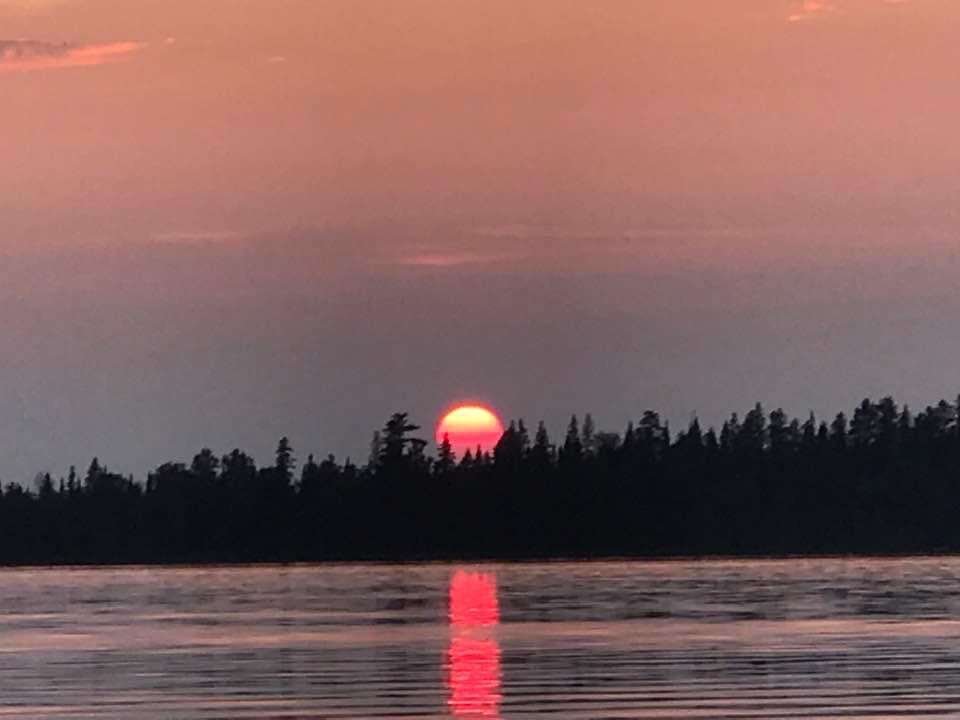
The lodge is gone now. But here's the thing - the reason it was built in the first place never went anywhere. The quiet lakes, the boreal forest, the colored sunsets, the fishing that drew people from across the continent. That's all still right here.
So when you settle in at the point, you're stepping into a tradition that runs back over a century of people coming to these exact waters to slow down and breathe. The grand hotel didn't last. The good land did.
Now - who's ready to go catch a walleye?